
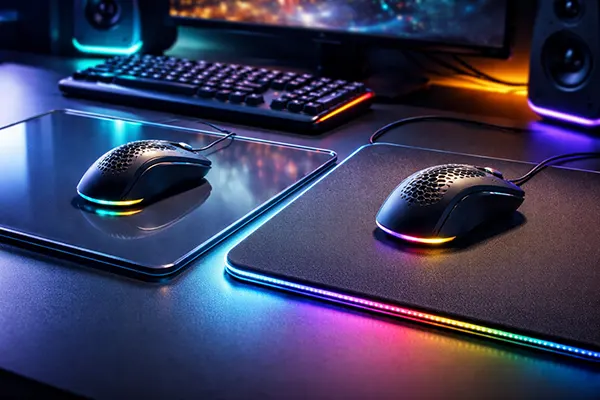
Periphery: Glass vs Cloth Mouse Pad in 2026 — Control, Speed, Skate Wear, and Sensor Nuance
In 2026, the mouse pad is no longer a “nice to have” accessory: it’s a part of the aim system. With modern lightweight mice, high-end sensors, and 4K–8K polling becoming common on competitive setups, the surface under your skates can change how your crosshair starts, stops, and corrects. Glass and cloth pads can both feel “fast”, but they get there in very different ways, and those differences show up most in FPS micro-adjustments, fast flicks, and long-term consistency.
Micro-adjustments in FPS: why surface feel matters more than you think
Micro-adjustments are the tiny corrections you make while tracking a moving target or holding an angle—often at the end of a swipe, when your hand tension rises and your grip tightens. Cloth pads usually help here because the weave adds subtle “mechanical damping”: when you nudge the mouse, the start of motion has a little resistance, and that can make fine corrections feel more deliberate. For many players, this translates into steadier crosshair placement during slow strafes and cleaner last-second corrections when recoil control forces small movements.
Glass pads tend to reduce that damping. When the surface is consistent and the skates are smooth, the mouse starts moving with very little effort, which can feel effortless for tracking, especially when your sensitivity is on the lower side and you rely on arm movement. The trade-off is that the same low resistance can make “over-corrections” easier, particularly if you squeeze the mouse during tense fights. On glass, micro-corrections can feel quick and crisp, but you may need a lighter grip and more disciplined finger control to keep them tight.
There’s also a practical angle: cloth pads can change feel across the pad if the weave wears or if oils build up where your hand rests. Glass is usually more uniform day-to-day, so if your aim depends on repeating the same tiny corrections, the “same spot, same glide” effect is often easier to maintain—assuming you keep skates and surface clean.
Stopping power vs speed: the part that decides your first bullet
Players often describe “control” as stopping power, but in real play it’s the combination of stop and restart. On cloth, you get a softer stop: the pad helps absorb motion, so it’s easier to halt the mouse without bouncing back. This can tighten your first bullet accuracy on angle holds, because you can stop your crosshair on a pixel edge and keep it there without constantly correcting.
On glass, stopping is more about technique and skates. You can stop very precisely, but it’s a sharper stop—more like braking on a smooth road. If your skates are thin or uneven, the stop can feel inconsistent, and that inconsistency shows up as tiny “twitch” corrections right after a flick. The upside is that when everything is dialled in, the stop-and-go rhythm can be extremely responsive, which is why some tracking-focused players like glass for fast target switches.
A simple test that reflects real FPS situations: place your crosshair on a corner, flick to a second corner, and try to stop dead without a corrective nudge. If you regularly need that extra nudge on cloth, you may benefit from the cleaner start of glass. If you regularly overshoot on glass, you may benefit from cloth’s damping—or from slower skates and a lighter grip rather than changing the pad immediately.
Friction, PTFE skate wear, and the “stick” feeling on fast flicks
Friction is not one number. There’s static friction (how much force it takes to start moving) and dynamic friction (how it feels once you’re already moving). Cloth pads often have higher static friction than dynamic friction, which can feel like a tiny “grab” at the start of motion. That grab can be helpful for control, but it can also create a sticky sensation during rapid micro-flicks if your skates are worn or if humidity makes the fabric slightly tacky.
Glass pads typically reduce static friction, so the start of motion is easier and more repeatable. That’s why many people describe glass as “effortless” or “floaty”. The downside is that PTFE skates tend to wear faster on harder, more abrasive surfaces—especially on etched or textured glass designed for more control. The wear is not just cosmetic: as skates thin, you can lose smoothness and start to feel scratchiness, which changes both glide and sound.
The “stick on fast flicks” problem can happen on either type, but for different reasons. On cloth, it’s often moisture, dirt, or compression of the weave where you flick most. On glass, it’s often skate condition: edges rounding unevenly, dust acting like grit, or a mismatch between skate material and surface texture. If flicks feel like they hesitate mid-swipe, don’t assume it’s your technique—check the surface and skates first.
How to manage wear and keep glide consistent for months
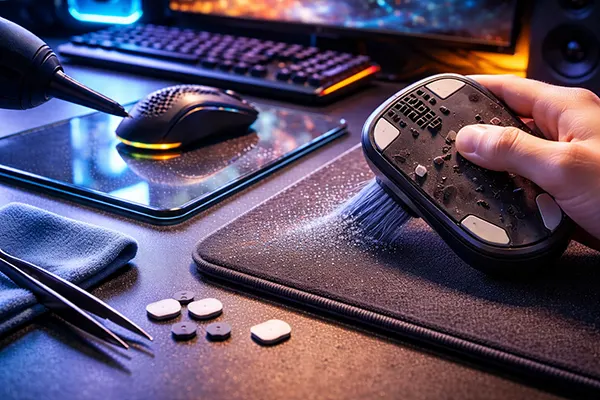
For cloth pads, consistency is mostly about cleaning and avoiding localised wear. A quick routine helps more than deep-cleaning once a year: wipe the pad lightly to remove skin oils, keep food and drink away, and consider a simple sleeve if your skin drags and you sweat. If your pad has stitched edges, check for raised seams; they can change glide when you swipe near the border, especially at low sensitivity.
For glass pads, consistency is mostly about skate maintenance and dust control. A single hair or speck of grit can be loud and can create a “micro-bump” that you feel during tracking. Wipe the surface before sessions, and keep spare skates ready if you’re training daily. If you notice the mouse becoming louder or feeling scratchy, it’s usually a sign that either skates are worn or debris is trapped at the edge of a skate.
If you want a practical rule of thumb for 2026 setups: the faster and harder the surface, the more often you should inspect skates. Many players switch from large skates to smaller dots on glass to fine-tune speed and reduce contact area, but dots can also wear unevenly if your base isn’t perfectly flat. Whatever you pick, the goal is repeatability—your aim adapts to a consistent feel far faster than it adapts to a surface that changes week to week.
Sensor nuances in 2026: 4K–8K polling, high sensitivity, and surface compatibility
With 4K and 8K polling, the system reports motion more frequently, which can make imperfections more noticeable. If your pad has a very pronounced texture, you may feel “grain” in the cursor path—not because the sensor can’t track, but because the physical movement is being sampled more often and your hand notices the micro-variations. Cloth with a fine weave often feels smoother at high polling because the texture is smaller and more uniform under the skates.
Glass is usually optically consistent, but it introduces its own quirks. Some coatings and etching patterns can change how lift-off and re-landing feels, especially for high sensitivity players who pick the mouse up often. If you run a low lift-off distance and you reposition aggressively, you may notice that certain glass surfaces feel “sharp” on re-contact, almost like the mouse snaps back into motion. That’s not necessarily tracking failure—it’s often just the difference in how the skates reconnect with a hard surface.
Another 2026 reality is that players mix settings: a lightweight mouse, a very low DPI with high in-game sensitivity, or the opposite. High sensitivity amplifies small inconsistencies: any start friction or sticky patch becomes more obvious because the distance you need to move for a correction is tiny. If you’re a high-sens wrist aimer, surface smoothness and stable static friction matter as much as raw speed.
Quick checklist for low/mid/high sens (and what to change first)
Low sens (large arm swipes, big pad use): prioritise a surface that stays consistent across the whole pad and doesn’t punish long sessions. Cloth control pads and some smoother glass pads both work, but choose based on whether you prefer soft stopping (cloth) or effortless glide with more technique-based stopping (glass). First things to tune before changing pads: desk height, pad size, and whether you’re gripping too hard during fights.
Mid sens (mixed arm and wrist): look for balance—predictable starts and reliable stops. Cloth is often the safer default because it dampens small errors, but a controlled glass surface can be excellent if you maintain skates and keep the surface clean. First things to tune: skate type (slower vs faster PTFE), sleeve use if your arm drags, and a consistent cleaning routine.
High sens (wrist aim, frequent micro-corrections): focus on low static friction and a surface that doesn’t change with humidity. Many high-sens players like smoother cloth or glass for the clean start of movement, but the best choice is the one that keeps your “start” consistent when you’re tense. First things to tune: grip pressure, lift-off behaviour (how often you reset), and whether worn skates are adding unwanted stick or scratch.
-
 Periphery
ROG Xbox Ally X in 2026: Auto SR, Ryzen AI...
Periphery
ROG Xbox Ally X in 2026: Auto SR, Ryzen AI...The ROG Xbox Ally X occupies an unusual position in 2026. It is …
-
 Periphery
500Hz QD-OLED Monitors for Esports: Is the...
Periphery
500Hz QD-OLED Monitors for Esports: Is the...For competitive gaming, 360Hz used to represent the point where refresh rates had …
-
 Periphery
PCIe 5.0 SSDs in Modern Games: Do Faster D...
Periphery
PCIe 5.0 SSDs in Modern Games: Do Faster D...PCIe 5.0 SSDs have become one of the most talked-about upgrades for gaming …
-
 Games
Neverness to Everness Review: An Open-Worl...
Games
Neverness to Everness Review: An Open-Worl...Neverness to Everness is an upcoming open-world action RPG developed by Hotta Studio, …