
Gamer Ergonomics 2026: How to Prevent RSI and Wrist Pain During Long Sessions
Extended gaming sessions remain a daily routine for millions of players in 2026, from competitive esports athletes to casual evening gamers. However, wrist pain, numb fingers and repetitive strain injury (RSI) are no longer rare complaints — they are among the most common musculoskeletal issues reported in gaming communities. Preventing these problems requires more than a “better chair” or a soft wrist rest. It demands an understanding of biomechanics, load management and evidence-based ergonomic practice. This guide outlines practical, medically grounded strategies to help reduce strain and protect long-term hand health.
Understanding RSI in Gamers: Causes and Early Warning Signs
Repetitive strain injury is not a single diagnosis but a group of conditions affecting muscles, tendons and nerves due to repeated movements and sustained postures. In gamers, RSI most often manifests as tendinopathy of the wrist extensors, De Quervain’s tenosynovitis, or early carpal tunnel syndrome. The core mechanism is cumulative microtrauma: small, repeated loads without adequate recovery.
Modern gaming hardware has improved responsiveness and reduced latency, yet input frequency has increased. Competitive titles can require 200–300 actions per minute. Even low-force keystrokes, when repeated thousands of times per session, create sustained tendon friction and local inflammation. Over time, tissue capacity is exceeded.
Early signs should never be ignored. These include tingling in the thumb or index finger, stiffness on waking, aching after sessions lasting more than two hours, reduced grip strength and discomfort when rotating the wrist. Addressing symptoms at this stage dramatically reduces the risk of chronic injury.
Why Wrist Position and Load Distribution Matter
The neutral wrist position — where the hand is aligned with the forearm without bending up, down or sideways — minimises compression within the carpal tunnel and reduces tendon friction. Even 20 degrees of sustained extension significantly increases pressure within the wrist joint. Many gamers unknowingly maintain extension while using a high keyboard or angled mouse.
Load distribution also plays a critical role. Resting the wrist on a hard desk edge concentrates pressure on superficial nerves and tendons. Contrary to common belief, wrist rests are not designed to support weight during active play; they are intended for pauses between inputs. Continuous pressure can aggravate nerve irritation.
Mouse grip style influences strain patterns. A tight fingertip grip increases extensor tendon workload, while a relaxed palm grip distributes load across larger muscle groups. In 2026, ergonomic mouse designs increasingly favour wider bodies and adjustable height to promote neutral alignment, but correct usage remains essential.
Optimising Your Gaming Setup for Joint Protection
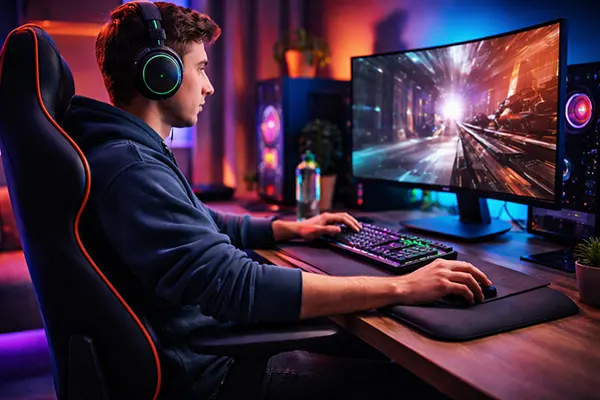
Desk and chair height should allow elbows to rest at approximately 90–100 degrees with shoulders relaxed. When the desk is too high, players elevate their shoulders and extend their wrists; when too low, they flex forward, increasing forearm strain. Adjustable desks have become more common, allowing players to fine-tune their working angle.
Keyboard placement should keep the forearms parallel to the floor. A slight negative tilt — where the keyboard slopes away from the user — often reduces wrist extension compared to the traditional upward tilt. Mechanical keyboards with lower actuation force (around 35–45g) can decrease repetitive loading, particularly during competitive play.
Mouse sensitivity settings also affect physical stress. Low DPI settings requiring large arm movements may protect the wrist but strain the shoulder; excessively high DPI encourages micro wrist flicks. The goal is balance: movement initiated from the elbow with minimal isolated wrist deviation.
Peripheral Choices and Evidence-Based Adjustments
Split keyboards and vertical mice are no longer niche tools. Studies in occupational ergonomics have shown that reducing forearm pronation and ulnar deviation lowers tendon strain. While adaptation takes time, many gamers report decreased discomfort after a structured transition period of two to three weeks.
Controller users face different challenges. Sustained thumb abduction and trigger tension can lead to tendon overload. Adjustable trigger stops and textured grips can reduce unnecessary force. Periodic hand repositioning during cut-scenes or loading screens helps maintain circulation.
Surface friction matters as well. A high-resistance mouse pad increases muscular effort. Modern hybrid fabric pads designed for controlled glide reduce micro-resistance without sacrificing precision, thereby lowering repetitive stress during rapid tracking movements.

Movement, Recovery and Long-Term Prevention Strategies
No ergonomic setup can compensate for uninterrupted six-hour sessions. Tissue recovery requires circulation and mechanical variation. The widely accepted 50–10 principle — 50 minutes of activity followed by a 10-minute break — aligns with occupational health guidelines and reduces cumulative load.
During breaks, active recovery is more beneficial than passive scrolling. Gentle wrist circles, finger extensions against light resistance bands, and forearm stretches improve tendon gliding. Evidence from sports physiotherapy suggests that eccentric strengthening exercises enhance tendon resilience over time.
Hydration and general conditioning are often overlooked. Dehydrated connective tissue becomes less elastic. Strength training that includes grip work, forearm strengthening and scapular stability indirectly supports wrist health by distributing mechanical demand across larger muscle groups.
When to Seek Professional Advice
If pain persists for more than two weeks despite load reduction, or if numbness extends beyond the hand into the forearm, professional assessment is advisable. Early intervention by a physiotherapist can prevent chronic nerve compression or tendon degeneration.
Night-time symptoms, particularly numbness in the thumb, index and middle fingers, may indicate developing carpal tunnel syndrome. In such cases, temporary night splinting to maintain neutral wrist position is often recommended by clinicians.
In 2026, many esports organisations integrate regular musculoskeletal screening into training programmes. Even casual players can adopt a similar mindset: prevention is significantly less disruptive — and less costly — than rehabilitation. Protecting wrist health is not about limiting performance; it is about sustaining it for years to come.
-
 Periphery
Hall Effect Keyboards in 2026: Do Magnetic...
Periphery
Hall Effect Keyboards in 2026: Do Magnetic...Hall Effect keyboards have shifted from niche hardware into a serious talking point …
-
 Games
Resident Evil Requiem: How the New Entry D...
Games
Resident Evil Requiem: How the New Entry D...The Resident Evil series has undergone a notable transformation over the past decade, …
-
Periphery
Gamer Ergonomics 2026: How to Prevent RSI ...
Extended gaming sessions remain a daily routine for millions of players in 2026, …
-
 Periphery
: Glass vs Cloth Mouse Pad in 202...
Periphery
Periphery: Glass vs Cloth Mouse Pad in 202...In 2026, the mouse pad is no longer a “nice to have” accessory: …