
ROG Xbox Ally X in 2026: Auto SR, Ryzen AI Z2 Extreme and a New Era for Windows Handhelds
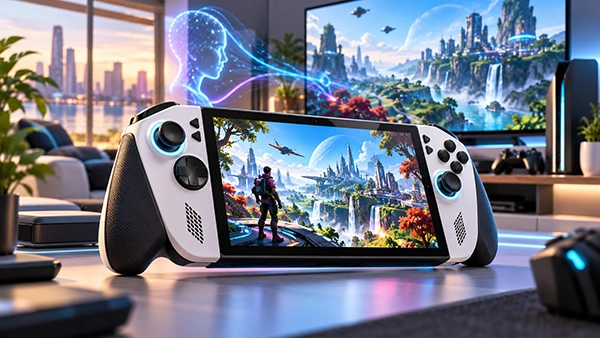
The ROG Xbox Ally X occupies an unusual position in 2026. It is not simply a compact gaming PC with Xbox branding, nor is it a traditional console reduced to handheld size. ASUS, AMD and Microsoft have gradually turned the device into a test case for what Windows gaming can look like when it is designed around a controller rather than a keyboard and mouse. The original ROG Xbox Ally X combines the Ryzen AI Z2 Extreme processor, 24GB of LPDDR5X memory, a 1TB SSD, an 80Wh battery and a 120Hz Full HD display, while software changes introduced during 2026 have become almost as important as the hardware itself. Automatic Super Resolution, the Xbox full-screen experience, improved docked behaviour and a more unified game library all point towards a Windows handheld that behaves less like a miniature laptop and more like a dedicated gaming device. At the same time, the ROG Xbox Ally X20 announced for 2026 shows where ASUS intends to take the same idea next, adding an OLED screen and revised controls without abandoning the Ryzen AI Z2 Extreme at the heart of the machine.
Why the ROG Xbox Ally X Still Matters in 2026
The ROG Xbox Ally X that entered the market in 2025 remains a capable piece of hardware in 2026 because ASUS gave it considerably more headroom than a basic handheld PC. Its AMD Ryzen AI Z2 Extreme has eight CPU cores and sixteen threads, with a maximum boost frequency of up to 5GHz. AMD combines three Zen 5 cores with five efficiency-focused Zen 5c cores, while the integrated Radeon graphics use the newer RDNA 3.5 design with 16 graphics cores. More important for the direction Microsoft has taken in 2026 is the processor’s dedicated XDNA neural processing unit, rated at up to 50 TOPS. That additional AI hardware does not automatically make every game faster, but it gives Windows a separate resource for tasks such as machine-learning-based image reconstruction without placing the entire workload on the CPU or integrated graphics.
The rest of the specification remains well suited to modern PC games. ASUS equips the ROG Xbox Ally X with 24GB of LPDDR5X memory and a 1TB PCIe 4.0 NVMe SSD in the common M.2 2280 size, making future storage upgrades less restrictive than on handhelds built around shorter drives. The seven-inch touchscreen runs at 1920 × 1080 with a refresh rate of up to 120Hz, reaches a quoted 500 nits of brightness and supports AMD FreeSync Premium variable refresh rate. VRR is particularly useful on a handheld because games do not need to remain locked to an exact 60 or 120 frames per second to appear smooth. Small variations in performance can therefore be less distracting than they would be on a fixed-refresh display.
Battery capacity is another reason the Ally X remains relevant. Its 80Wh battery is large by handheld standards, although actual running time still varies dramatically according to the game, screen brightness, wireless use and selected power mode. A demanding new release can consume far more power than an indie title or an older PC game, so a single battery-life figure would be misleading. The device also weighs 715g, which makes it noticeably heavier than a Nintendo Switch but still practical as a portable PC. Two USB-C connections, including USB4, a UHS-II microSD reader, Wi-Fi 6E and Bluetooth 5.4 allow the machine to move between handheld and desktop-style use without requiring a completely separate set of accessories.
Ryzen AI Z2 Extreme Is More Than a Routine Processor Upgrade
The Ryzen AI Z2 Extreme matters because AMD did not treat it as a simple higher-clocked replacement for the earlier Ryzen Z1 Extreme. The older Z1 Extreme already offered eight CPU cores and strong integrated graphics, but the newer chip adds a revised CPU layout, RDNA 3.5 graphics and a dedicated NPU. Its configurable power range of roughly 15W to 35W also allows manufacturers to balance speed, heat and battery consumption depending on how the handheld is being used. At lower power settings, efficiency becomes more important; when connected to mains power or a dock, the device can operate closer to the upper end of its performance range.
For players, the practical benefit is not that every title suddenly runs at maximum graphics settings. A handheld still works within much tighter power and cooling limits than a desktop graphics card. The more important change is that there are now several ways to reach a sensible balance between image quality and performance. AMD’s own technologies include Radeon Super Resolution, FidelityFX Super Resolution and frame-generation options in supported situations, while Microsoft can use the NPU for its own Auto SR system. Games that already include a good built-in upscaler may still be best served by their native options, but older or less flexible titles can potentially benefit from system-level assistance.
The processor also helps explain why ASUS retained the same Ryzen AI Z2 Extreme for the 2026 ROG Xbox Ally X20 instead of replacing it after only one generation. ASUS describes the X20 as offering the same core performance foundation as the existing Ally X, with 24GB of LPDDR5X memory and 1TB of SSD storage, while concentrating the new model’s changes on the display, controls and physical design. That decision suggests that the current bottleneck in handheld gaming is not simply raw processor speed. Screen quality, interface design, power management, upscaling and the way Windows behaves without a mouse can have an equally visible effect on everyday use.
Auto SR Changes the Role of AI in Handheld Gaming
Automatic Super Resolution, usually shortened to Auto SR, is one of the most significant additions to the ROG Xbox Ally X during 2026. Microsoft began offering it in preview to Xbox Insiders on the handheld on 30 April 2026. As of September 2026, Microsoft’s own support documentation still describes ROG Xbox Ally X access as requiring Xbox Insider participation and a connection to an external display. In other words, Auto SR should not be described as a universal feature that is automatically active in every handheld game. Its present role is more specific: it is intended to improve the balance between performance and image clarity when the Ally X is docked to a television or monitor.
The idea is straightforward even though the processing behind it is more complicated. Instead of asking a game to render every frame at the final high resolution shown on the display, Auto SR allows it to run internally at a lower resolution and then reconstructs the image at a higher output resolution. Microsoft recommends an input close to 1280 × 720 on the ROG Xbox Ally X, with supported input resolutions generally sitting between 700p and 900p. Rendering fewer pixels reduces the amount of work required from the integrated graphics, while the AI-assisted reconstruction attempts to restore detail before the frame reaches the external screen. Microsoft says the docked preview is designed to produce detail approaching a 1440p presentation while retaining smoother performance, although results can naturally differ from game to game.
This matters more on a large television than it does on the Ally X’s own seven-inch screen. A 720p image can look perfectly acceptable when viewed on a small handheld display, but the same image becomes noticeably softer when stretched across a 27-inch monitor or a large living-room television. Raising the game’s native resolution can solve the sharpness problem but may reduce the frame rate. Auto SR is intended to reduce that compromise. It does not create additional graphics power, and it should not be confused with guaranteed frame generation. Instead, it tries to use the available hardware more efficiently by separating the resolution at which the game is rendered from the resolution the player ultimately sees.
What Players Need to Know Before Using Auto SR
Compatibility is not unlimited. Microsoft’s current requirements specify Windows 11 version 24H2 or later, fully updated graphics and neural-processing drivers, the current Auto SR package and a display resolution of at least 1080p. Supported games need to use DirectX 10 or later and run as native x64, x64-emulated or Arm64 applications. DirectX 9, Vulkan and OpenGL titles are outside the current support list, as are x86-only games and some applications that use unsupported display formats. This means a large PC library will not suddenly receive identical AI upscaling simply because it is installed on an Ally X.
The preview also includes Game Bar controls, making it possible to manage Auto SR without treating the handheld like a conventional desktop PC every time a setting changes. This is an important part of the feature because a technically capable system is of limited value on a handheld if it requires repeated visits to small Windows menus. Microsoft’s broader work on Game Bar follows the same principle: the Xbox button can bring up gaming tools and widgets while the player remains in a controller-oriented environment. Auto SR therefore represents both a graphics feature and an example of Microsoft moving more PC settings into interfaces that make sense on a seven-inch device.
It is also worth separating Auto SR from AMD FSR and Radeon Super Resolution. FSR is normally integrated into a game by its developer and can therefore use information supplied directly by the game engine. Radeon Super Resolution works at driver level and can be applied more broadly, but follows a different method. Auto SR sits within Windows and uses AI acceleration available on compatible hardware. None is automatically the best choice in every title. If a game has a well-implemented modern upscaler, its own setting may provide better control. Auto SR is potentially more valuable when a compatible game lacks a suitable internal option or when the player wants a simpler system-managed solution for docked use.

Windows Handhelds Are Becoming Less Like Small Laptops
The most important change surrounding the ROG Xbox Ally family may be Microsoft’s attempt to make Windows itself behave properly on a handheld. Traditional Windows offers enormous software compatibility, but that flexibility has historically come with inconveniences on small gaming devices: desktop pop-ups, launchers, taskbar elements, tiny controls and processes that make sense with a mouse but interrupt controller-based use. The Xbox full-screen experience changes that relationship. On the ROG Xbox Ally X, the device can start directly into a full-screen Xbox interface designed for gamepad navigation rather than showing the conventional Windows desktop first.
Microsoft’s documentation explains that the full-screen experience can suppress parts of the standard Windows environment, including the taskbar and some background startup services, leaving more memory and resources available to games. It can also return the user to the game or gaming interface after sleep and launch games directly in full-screen mode. This does not turn the Ally X into a closed console. The normal Windows desktop remains available, which means players can still install PC software, use different game stores, modify files and connect conventional peripherals. The difference is that these desktop functions no longer have to dominate the way the device behaves every time it starts.
The Xbox app has also become more useful as a central library. Microsoft’s current handheld design can surface compatible games from Xbox and other PC stores rather than restricting the interface to titles purchased from one source. During 2026, Xbox also continued adding features such as improved docking behaviour, a gamepad-controlled cursor and better handling of external displays. When an Ally X is docked, the system can move output to the television and turn off the handheld screen automatically, while supported televisions may switch into their low-latency gaming modes. These changes sound smaller than a new processor, but together they address many of the everyday irritations that previously made Windows handhelds feel unfinished.
ROG Xbox Ally X20 Shows Where the Category Goes Next
The ROG Xbox Ally X20 is the clearest sign of ASUS continuing this direction in 2026. Announced as a 20th-anniversary ROG model, it retains Windows 11, the Ryzen AI Z2 Extreme, 24GB of LPDDR5X memory, a 1TB M.2 2280 SSD and an 80Wh battery, but replaces the seven-inch IPS screen with a 7.4-inch OLED ROG Nebula HDR display. The new panel still uses a 1920 × 1080 resolution and 120Hz refresh rate, but ASUS specifies 600 nits for standard content and a peak of 1,400 nits for HDR, alongside Dolby Vision and FreeSync Premium Pro. For a device used at close viewing distances, better contrast, true black levels and HDR capability can be more immediately noticeable than a modest increase in benchmark performance.
ASUS has also revised the controls. The X20 uses TMR joysticks, a transforming D-pad, impulse triggers, revised bumpers and face buttons, and rubberised grips. TMR, or tunnel magnetoresistance, is a magnetic sensing technology designed to provide accurate stick input without relying on the same physical contact mechanism used by traditional potentiometer-based analogue sticks. The X20 also introduces microSD Express support and a more distinctive translucent black-and-gold body. These additions increase the weight to 756g, compared with 715g for the earlier Ally X, so the newer model is not simply smaller or lighter. It is aimed at improving screen quality and controls while preserving the established performance base.
As of 17 September 2026, the ROG Xbox Ally X20 has been announced and opened for pre-order in several markets, but ASUS states that retail availability begins on 15 October 2026 in markets such as the United States. That timing matters when comparing the two devices today: the original ROG Xbox Ally X is an existing product with a year of software development behind it, while the X20 is the next version waiting to reach shops. The broader direction is already clear, however. Windows handheld development is moving away from the idea that success depends only on fitting faster PC components into a smaller case. The 2026 Ally family combines capable hardware with AI-assisted image reconstruction, controller-first Windows behaviour, better docking and increasingly refined displays and controls. That combination is what makes the ROG Xbox Ally X more significant in 2026 than another routine handheld refresh.
-
Periphery
ROG Xbox Ally X in 2026: Auto SR, Ryzen AI...
The ROG Xbox Ally X occupies an unusual position in 2026. It is …
-
 Periphery
500Hz QD-OLED Monitors for Esports: Is the...
Periphery
500Hz QD-OLED Monitors for Esports: Is the...For competitive gaming, 360Hz used to represent the point where refresh rates had …
-
 Periphery
PCIe 5.0 SSDs in Modern Games: Do Faster D...
Periphery
PCIe 5.0 SSDs in Modern Games: Do Faster D...PCIe 5.0 SSDs have become one of the most talked-about upgrades for gaming …
-
 Games
Neverness to Everness Review: An Open-Worl...
Games
Neverness to Everness Review: An Open-Worl...Neverness to Everness is an upcoming open-world action RPG developed by Hotta Studio, …